Units of Length Smallest to Largest: All Units in Order
Reviewed by Umesh Upadhyay MCA

Length is among the core physical quantities that define the distance between two points. Length measurements belong on the microscopic scale, such as the distance between atoms, to even the distance between galaxies, and these can be measured in a variety of ways. These units belong mainly to two systems — Metric and Imperial — and range from nanometers to kilometers, and inches to miles.
What is the Largest Unit of Length?
The largest standard unit of length is the kilometer but for measuring astronomical distances, it is commonly seen as a yottaparsec or a ronnaparsec. In other words, for daily and metric measurements, the kilometer is the longest while astronomers also use light-years and parsecs as the largest unit of length.
Example:- The nearest star, Proxima Centauri, is about 4.24 light-years away from Earth.
What is the Smallest Unit of Length?
In the metric system, the millimeter is the smallest unit of length. This is the smallest unit in the metric system that is useful to us to measure small things, such as a grain of sand. This is the smallest distance that can be measured at all based on quantum effects.
For example:- A grain of rice or a tiny screw could easily be measured in millimeters. A typical object like a pushpin might be approximately 23 mm.
Metric and Imperial Units of Length
Metric units for length consist of the meter (m) as the base unit with common units being the kilometer (km), centimeter (cm), and millimeter (mm). Imperial units for length include the inch (in), foot (ft), yard (yd), and mile (mi).
Metric Units:-
Meter (m) – The base unit of length
Centimeter (cm) – Basically used for smaller measurements
Millimeter (mm) – Used for even smaller measurements
Kilometer (km) – Used for longer distances
Imperial Units:-
Inch (in) – A base unit for common lengths
Foot (ft) – Equivalent to 12 inches
Yard (yd) – Equivalent to 3 feet
Mile (mi) – Equivalent to 1,760 yards, or 5,280 feet
Read More: How to Convert Kilometers to Miles and Miles to Kilometers
Units of Length Smallest to Largest (in table)
Here is the common unit of length from smallest to largest consisting of metric and imperial units.
| Unit | Symbol | Example |
| Millimeter | mm | Coin thickness, pencil tip |
| Centimeter | cm | Width of a staple |
| Meter | m | Height of a door |
| Kilometer | km | Distance between towns |
| Mile | mi | Distance between cities |
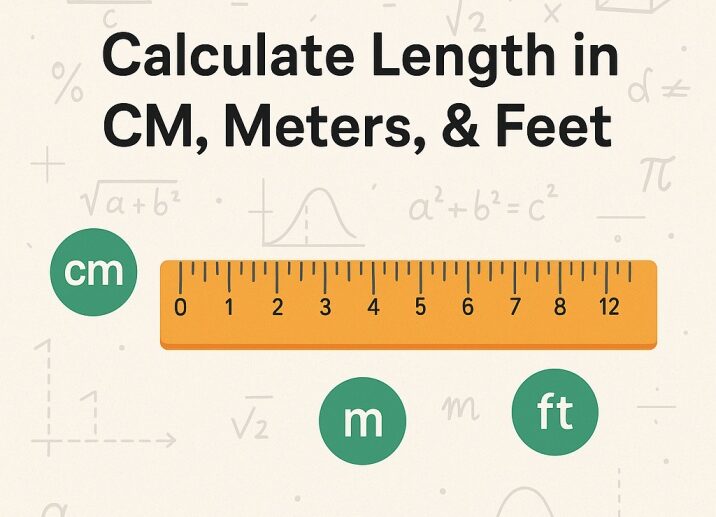
How to Calculate Length in Different Units
To find length in different measuring units, multiply or divide lengths using the conversion factor. For instance, to change meters into centimeters, you will multiply the number of meters by 100. To change kilometers into meters, you multiply by 1,000. If you are changing from a smaller unit to a larger unit, you will divide.
Basic Metric Conversions:-
- Kilometers to meters – Multiply by 1,000
- Meters to centimeters – Multiply by 100
- Centimeter to millimeters – Multiply by 10
Measure Unit of Length with TrueConverter
- Step 1: Go to trueconverter.com using your web browser.
- Step 2: On the homepage, look for the “Length” or “Distance” option in the unit section list, then click it.
- Step 3: Type the value you want to convert (for example, 100).
- Step 4: In the “From” drop-down menu, select the unit you are converting from, for example, centimeter (cm) or kilometer (km).
- Step 5: In the “To” dropdown menu, select the unit you want to convert to, for example, meter (m) or mile (mi).
- Step 6: Press the calculate button to see the accurate result immediately.
- Step 7: At last, the converted value will be shown on the screen, showing the proper measurement in your selected output unit.
Conclusion
Understanding different lengths, whether large or small, is essential for measurements in various fields, including life sciences and everyday situations. If you need to convert measurements—such as millimeters to meters or kilometers to miles—web-based tools like TrueConverter provide a quick and accurate way to perform these conversions.